
🎙️New on the Back Row podcast: John Galliano’s biographer Dana Thomas came back on the show to talk about the Met’s stunning decision to mount a retrospective of his work in 2027. We revisit the incidents that led to his firing from Dior, the toxic behavior that long predated it, and the apologies Galliano never made. This episode is available in full to paid subscribers in Apple Podcasts and Spotify.
Upgrade your subscription to listen.
Premium subscribers can access paywalled podcasts through Supporting Cast. Enter the email address affiliated with your subscription, and you’ll receive a link to set up a feed to access paid episodes.
I’d be grateful if you spent a couple of minutes taking Back Row’s first-ever denim survey! I’m curious what jeans you love and recommend. I’ll report back the community’s picks in a future issue.
Loose Threads
Olivia Rodrigo is promoting Planned Parenthood by sharing some basic facts about the organization, women's healthcare, and common abortion medication. This was so refreshing to see in a world where so many celebrities are preoccupied with profiteering off supplements and wellness fads that are unproven at best and dangerous at worst.
According to Bloomberg, Chanel's fashion sales are up 16 percent in the first half of the year, notable because LVMH's latest earnings report only showed 1 percent growth and many in the sector are still down. People are crediting the spike to Matthieu Blazy's designs.
Fashionphile is holding a popup in NYC August 7 - 9, featuring Chanel bags that start at $600. They'll also host events, including authentication classes, each day, so you can learn how to spot a counterfeit.
Denim Tears's fall collection is inspired by André Leon Talley and holds the distinction of being the first and only line made in collaboration with his estate. It drops August 14 on the Denim Tears site and in African Diaspora Goods on Spring Street in NYC. Founder Tremaine Emory said in a release, "André was the first in fashion to herald Black fashion designers such as Phat Farm, Billionaire Boys Club, Dapper Dan etc, showing up front row at shows and wearing their clothes at a time when no one else did in the fashion world."
Luxe fragrance brand Bond No. 9 wants you to smell like your New York neighborhood, and I'm kind of obsessed with their description of this iconic And Just Like That filming site which seems not quite accurate to me, but "a rule-breaking symphony of tenacious forest notes" does sound nice.
Ahead, today’s big story…
The OpenAI Influencer Trip Worked Exactly as Planned
A new proxy has emerged in our collective fear and hatred of AI data centers: the influencer.
We’ve seen this movie before. A brand takes influencers on a trip, they post propaganda-ish but still aesthetic content from said trip, and quite often, the response is anger: Why do we have to look at influencers riding camels on a luxury trip to Dubai in the name of blush, when I’m sitting here in sweatpants and a Zoom top talking about KPIs in Slack?
OpenAI recently treated a group of influencers to a luxury stay in upstate New York at Wildflower Farms where they all had their own cabins, which run around $2,500 per night, with deep tubs and bath salts and a field of wildflowers at their doorstep. When they weren’t learning how to use ChatGPTWork, “which can help users with tasks like drafting documents and presentations,” they kept bees and did something I’ve seen called “farming” but is probably more like “observing gardening.” They ate dinner at a long table in a forest. It looked gorgeous, the landscape only interrupted by a wood carving of the OpenAI logo and influencers filming everything instead of actually enjoying it. It was kind of like a wedding, if the wedding were also a company off-site.

OpenAI trip content from @meglovesdata and @nat.lucyy
While it seems obvious to get furious at people whose luxury “summer camp” was funded by what may be today's most loathed tech company, lots of brands — in tech and otherwise — have done influencer trips simply because it’s basic marketing. And yes, influencers have been a proxy for our hatred of lots of things — SHEIN, Coachella, any luxury travel paid for by Tarte Cosmetics, a failure to appreciate artisanal baskets. As we saw with the infamous SHEIN trip, where TikTokers told us how great the company's factories are, creators are a useful way for brands to redirect outrage away from them and toward random people.
This particular OpenAI trip, however, outraged social media users seemingly more than the data centers emitting the noise of a thousand banshees right next to people’s homes. They were dragged for being sustainability grifters, for enjoying nature that AI companies want to casually annihilate with data centers, for accepting gifts from a company that received a $200 million contract from the defense department, and for "selling [their] morals."
But, is this hatred not the entire point? Brands used to fear backlash hurting their images. Now, they pay to manufacture it and market against it because they can't break through the algorithm otherwise.
Support Independent Fashion Journalism
Some of Back Row’s most popular recent stories:
My full take on the Met’s upcoming John Galliano exhibition.
Are old Chanel flap bags as embarrassing as Birkins? Definitive answers from people who own them.
Do you have Chanelmania yet? Nine people who do explain how they afford it.
Four years ago, I wrote about the disaster of Revolve Fest. Revolve Fest was a Coachella barnacle — an event with Kendall Jenner and musical performances and brand activations. If there was a new canned drink in a bright color and questionable flavor profile, it was probably marketed at Revolve Fest. But more importantly, it seemed devised to make Revolve itself more cultural entity than mere purveyor of crocheted pants. Revolve’s strategy was to stuff this thing with influencers and let their content seed social media. Only, to get to Revolve Fest in 2022, the influencers had to wait hours for a bus in a dusty parking lot with no water, which led to a rash of TikTok videos of sandy, dehydrated influencers complaining and subsequent comparisons to Fyre Fest. (In all seriousness, both Fyre Fest and trying to get to this Revolve Fest sounded terrible.)
Revolve later issued a statement saying, "We sincerely apologize to all the guests who were impacted." People like me thought it was a bad look — a party-girl fantasy brand reduced to the misery of a parking lot. I wrote that brands were failing to adapt to the TikTok age, when telling a personal story or complaining about a company generated more clout than sharing pictures of cocktails in coconuts and pool floats.
Then, in 2023, Tarte Cosmetics sent TikTokers, including Alix Earle, on the “Trip of a Lifetime” to Dubai. The pandemic was ending and people were starting to feel comfortable traveling again, but many were still stung by the economic impact. The trip went viral after people accused it of being "tone deaf." But Tarte kept going, sending influencers to Bora Bora, Necker Island in the B.V.I., NYC, and elsewhere. Tarte founder Maureen Kelly said the influencer trips tied directly to sales. Before they were ragebait, they worked. And once they became ragebait, they still worked. Earle later said on her podcast, "I just remember everyone talking about this trip."
Now, standing out on Instagram has become so challenging that beauty brands are resorting to faking controversy. Colourpop posted a carousel with text saying, "Addressing THAT deleted post…" because that kind of thing "stops the scroll." (They were pretending, they didn't actually remove it.) Dieux shared content about its decision to "pivot into AI." And Lancôme sent gift packages to the wrong celebrities. “I’m not going to send it to her, I’m going to keep it!” said Isabella Rossellini opening a package addressed to Demi Moore. Crazy stuff.
Fashion brands seem to be doing it, too. American Eagle's summer 2025 denim campaign with Sydney Sweeney saying she had "great jeans" generated so much controversy it basically became its own little culture war, with Trump eventually expressing his approval for it/her. New York magazine found that clipping campaigns, in which people pay clip farmers, often overseas, to flood social platforms with videos so that we all see it, were at work here:
The bot-detection firm Cyabra analyzed seven days of activity around the ad and determined that 15 percent of the TikTok accounts commenting on it were fake but had created a disproportionately large percentage of the uproar. “The public reaction wasn’t all fake,” Cyabra’s CEO, Dan Brahmy, says. “But it was amplified by inauthentic activity.”
American Eagle didn't distance from the campaign. In fact, it saw a bump in stock price around the time it dropped, though that also could have stemmed from a favorable earnings report. It retains Sweeney as a spokesmodel.
This helps explain why brands are sponsoring influencers who lean into rage bait in order to stand out, in what New York magazine recently termed the "influencer recession." If brands are doing it, it’s a logical way to try to earn a slice of their marketing budget.
Only, the influencers know they’re playing into OpenAI’s hands. The backlash crowd may not want to admit it, but they also are — equally if not more so — by surfacing this content.
The problem is that when rage is bought and sold, it becomes meaningless. Maybe that's how you end up in a moment like this one, when institutions like the Met and companies like Condé Nast feel like they can get away with a John Galliano Met Gala.
If you like this story, you're a Back Row person. A Premium subscription gets you behind the paywalls, where the juiciest scoops live.
Check Out Prada's $3,000 "Dirty" T-Shirts
Fitting news for an issue about ragebait: Prada's men's pieces that are made to look dirty on purpose are now available for purchase. Here's what a nearly $3,000 cotton T-shirt looks like.

And here's another that's (only?) $2,400.

If you're on a budget, the tank top can be had for a mere $1,300.

Outrageous prices aside, some have noted that this stuff is derivative of Margiela.
Does the Galliano Show Mean Anna Wintour Is Retiring?
I've been asked if I think Anna Wintour will retire now that she's succeeded in convincing the Met to stage the Galliano retrospective. I get the speculation — the exhibition and Galliano's image rehabilitation have been longtime goals of hers, so maybe it's time to hang up the sunglasses or whatever — but I don't necessarily think this is a sign of that. She often talks about how much she admires Karl Lagerfeld, who worked until he died.
What I feel in my bones is that if she does ever decide to retire, she won't tell a soul about it. Case in point: when she gave Chloe Malle the parts of Vogue she no longer wants to deal with, she broke the news.
Miranda Kerr Is off Sushi, Still Loves Caviar
It's been a while since an extreme celebrity diet made the news. Allow Miranda Kerr — the model/beauty brand founder and wife to Snap founder Evan Spiegel and therefore one of the only people to ever wear Snap Specs — to break that cycle. She went on the Let's Be Honest With Kristin Cavallari podcast and talked about what she eats in pseudoscientific terms.
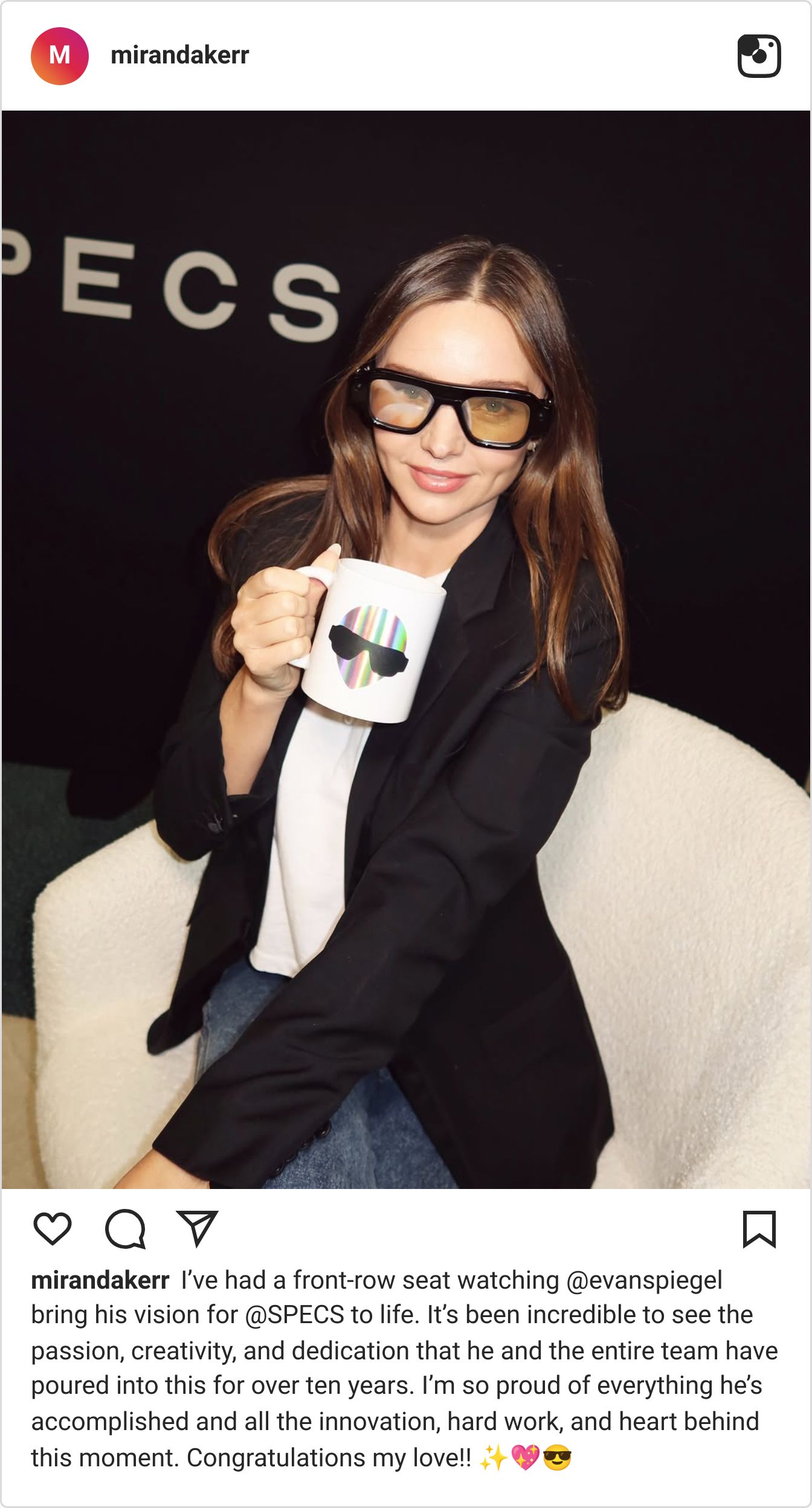
“I don’t do eggs,” she said. “I do protein. So I eat all meats like venison, bison, lamb, turkey. I eat all the meats that aren’t mass produced for the reasons that we all know.” Asked if she eats sushi, she said "never" because of "parasites." (Gwyneth Paltrow, according to my reporting, at one point didn't eat sushi either for the same reason. Though your risk of getting a parasite from eating sushi at a reputable restaurant is quite low.) Kerr added, “I do love caviar. There’s no parasites. It is good for you.”
She also doesn't eat kale, spinach, or wheat and said her diet stems from IBS. “And then I’m very specific about the oils. So only cooking with coconut oil or avocado oil; no seed oils. Olive oil is okay on salads, but not to cook with."
I'll never understand what seed oils did to stars. Here's a great article on them that clears up some common misconceptions.


Amy Odell is the New York Times bestselling author of Gwyneth: The Biography; Anna: The Biography; and the essay collection Tales from the Back Row: An Outsider’s View from Inside the Fashion Industry. Write her at amy (at) amyodell (dot) com. Submit a tip or story request anonymously here.
Partnership inquiries: [email protected]
Back Row may earn commission if you purchase through affiliate links in this newsletter, which helps support the operations of this publication.
