
🎙️New on the Back Row podcast: NYT bestselling author and veteran fashion journalist Dana Thomas returned to the pod for Fall 2026 Couture Awards! We made picks for best shoes, best unwearable look, most viral celeb, and much more. Listen to a free teaser in Apple Podcasts, Spotify, and YouTube.
The full episode, in Apple Podcasts and Spotify, is available to paid Back Row subscribers. Upgrade to Premium listen/watch.
Premium subscribers can access paywalled podcasts through Supporting Cast. Enter the email address affiliated with your subscription, and you’ll receive a link to set up the private feed.
Loose Threads
Partner message: You know how when you go away you often end up traveling with whatever products you can find in travel size, even when it’s not your favorite stuff? Merit (which I’ve been using for all my podcast glam of late) has a new, limited edition travel kit (available through July 23) that solves that problem. It includes my absolute favorite cleanser, along with a baby serum, flush balm, and mascara. I’m also obsessed with their cream shadow in SARTORIAL (I mean), which doesn’t budge and can look as vibrant or minimalist as you want. Spend $75 USD or more and get a Ritz-Carlton keychain included with your purchase while supplies last.
Shein will have a hearing about going public on the Hong Kong stock exchange Thursday, according to Reuters’s sources. Assuming Shein obtains clearance following the hearing, it could go public at a valuation of $40 to $50 billion around September or October.
Olivier Rousteing has been officially named the creative director of Rabanne. Which gives us another debut to look forward to in March 2027.
Dolce & Gabbana’s Alta Moda show seems to be getting high marks as our collective eye embraces a new opulence. (Front row headliner Jennifer Lopez looked spectacular.) The Telegraph reports that the dresses cost upwards of six figures (typical for couture) and “usually by the next day they are snapped up.”
Rihanna wore Saint Laurent to perform with Jay Z at Yankee Stadium over the weekend, while her 10-month-old daughter Rocki wore a Fendi dress.
Which brings us to today’s big story…
Phia Called Out for Alleged ‘Fraud.’ Will It Matter?
Phia is a browser extension that promises to find shoppers the lowest prices on fashion items and surface those same items on secondhand sites, like Depop and TheRealReal. Launched last year, the company became a media sensation largely owing to its founders, Bill Gates’s daughter Phoebe and her Stanford roommate Sophia Kianni. Gates drew headlines for obvious reasons. She came to her interviews (including ours) prepared to discuss nepotism and privilege.
Gates and Kianni also discussed ambitions to grow Phia into an AI shopping agent that could do things like tell you which size to buy based on your previous purchases and curate a list of items based on your taste.

Sophia Kianni and Phoebe Gates (Photo: Cindy Ord/Getty Images for Hearst)
Only, Bloomberg now reports that Phia was taking credit for affiliate sales it did not generate through a practice known as "cookie stuffing," prompting an avalanche of commentary from creators spanning fashion, venture capital, and software engineering. Many are calling this “fraud” and saying they find it hard to believe that this is the result of a bug. Chaya G, for instance, said that while she didn't think this was an accident, it’s possible Gates and Kianni didn’t know it was happening. Venture capitalist Kate McAndrew said Phia should “find some really good lawyers” and give back the money it’s raised.
This scandal seems unlikely to make much of a dent in Phia, which has had an extraordinary and rapid rise over the last 18 months. The whole situation underscores the tenuousness of the modern affiliate economy. Many creators use such links to monetize their newsletters and social media content. Affiliate earnings are generally small, the majority of whom struggle to grow revenue and reach. Every so often, a tech-world baddie finds a way to bury creators' affiliate links. Instagram previously did this with its Shop the Look feature, which surfaced knockoffs of creator-chosen items. Creators often attract attention for addressing these betrayals. But unfortunately, there's often no way to stop these well-funded — and in Phia's case, even better-connected — tech companies.
Support Independent Fashion Journalism
Paid subscribers recently got these exclusive stories:
Bridezillas? Try again. A luxury wedding planner says nine out of ten problems stem from grooms.
A new series just dropped: “Facelift Confessions,” in which women who got work done get honest about how it really felt. In the first installment, hear from someone who endured complications after traveling to Turkey and someone who stayed local.
Hear from the decades-long Birkin owners who find the bags embarrassing now.
Phia enjoys the distinction of being called “the most celeb-backed shopping startup of all time” in a Vogue Business headline. Angel investors include Kris Jenner and Spanx founder Sara Blakely. So many celebfluencers cut checks that it announced its $35.5 million Series A funding in a fake Coachella lineup listing blue-chip firms like Kleiner Perkins, Notable Capital, and Khosla Ventures alongside Page Six regulars like Sydney Sweeney, Alix Earle, and Shaboozey.
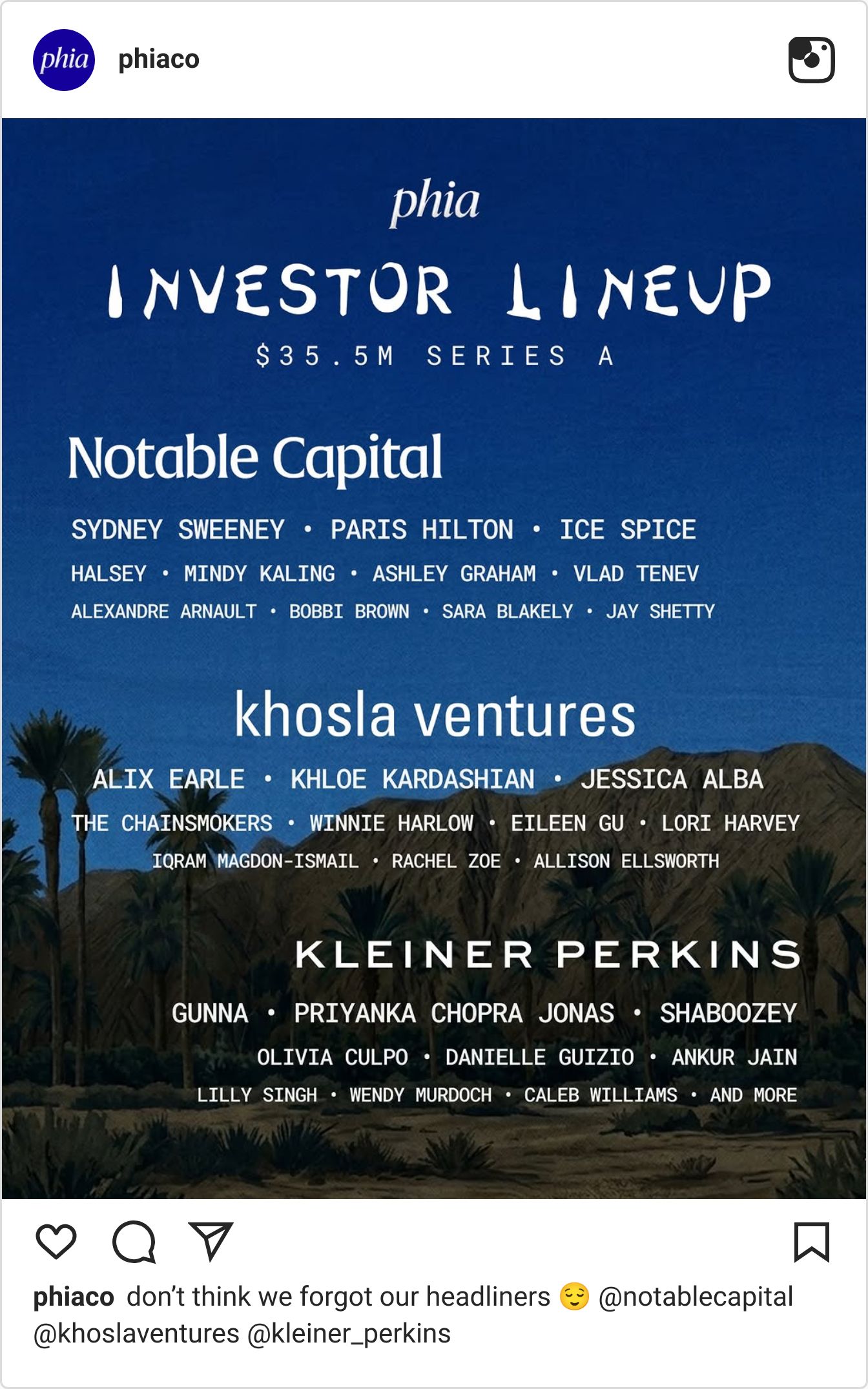
Gates and Kianni have memed and podcasted Phia’s way to more than 300,000 Instagram followers and the kind of visibility aspiring tech moguls would kill for today, the way 22-year-olds used to get homicidal to be the ones delivering Anna Wintour her daily lattes. Their success seems like an archetypal dream career for young women — one combining glamour, internet clout, Ivy League degrees, celebrity, generational wealth, and entrepreneurial spirit ostensibly rooted in social good, all while identifying and attempting to solve a very real problem: that online shopping is neither pleasurable nor particularly easy.
Phia's last scandal in November, just two months after raising its $8 million seed round, has not stood in its way. At the time, Fortune reported that Phia was collecting a “concerning amount of user data.” Four cybersecurity experts explained that the browser extension had been capturing information, including bank statements and private emails in Gmail, even when users weren’t on ecommerce sites.
Ex-Meta software engineer Maahir Sharma first noticed these issues and told Fortune they left him “at a loss for words.” Sharma contacted the company with his findings, and it removed the code that captured all this data, but did not disclose its collection of sensitive data to users. A Phia spokesperson told Fortune at the time that the company had never stored this data and noted that Chrome users “had to click OK on a pop-up box noting that the tool can ‘read and change all your data on all websites.’”
This contradicts what Kianni told me during our interview. I asked about it directly, because when downloading a test version of the app to prepare for the call, I felt nervous about privacy:
So when you download the Phia browser extension, you get a message from Safari about privacy and data. Can you guys talk about that? I know people are going to get that and be nervous to proceed. What are you doing to protect user privacy and data?
Kianni: If you're on Gmail, Phia is not showing up — we only show up on shopping websites. We don't use or do anything with your data. You giving us permission allows us to show up on shopping websites.
After the Fortune story came out, TechCrunch wrote, “Hopefully that incident is remembered as a growing pain for the startup, and not an indicator of problems to come — because Phia is right that online shopping could use a makeover.”
Last year, Phia did a lot of reach-out to fashion journalists and creators, placing interviews and seeking other unpaid promotion. I interviewed Gates and Kianni last spring after they pitched me on coverage. Kianni, a climate activist focused on fast fashion, told me that Phia stemmed from her desire to get people to buy secondhand clothing instead of new. She explained that Phia was primarily monetized through affiliate sales, meaning it got a kickback when it drove a purchase. (Kickbacks tend to be higher and easier to generate for new purchases, so it’s hard to see how the app, long-term, would remain incentivized to plug resale over new items.)
Bloomberg tested the extension across more than 50 sites and discovered that while checking out, Phia would open a background tab containing its own referral code that wiped out the code from other referral sources, a practice known as “cookie stuffing.” Capital One Shopping, which makes a competing product, and independent researcher Ben Edelman found the same thing in their own analyses. Edelman has stated that this should have been discovered during due diligence before the Series A closed.
Bloomberg found that, after it reached out to Phia about this on July 7, the browser extension ceased cookie stuffing. A spokesperson told them, “Within the last 24 hours, we were made aware that in a recent release our codebase was causing misattributions from a subset of users.” That code was introduced in December, per Bloomberg.
A number of software engineers have posted social media videos expressing disbelief that the code was an error. One, Carol Liang, explained that she didn't think it was a bug because it was confined to mobile sales and would have had to be coded as such. (It would be more obvious to users if Phia was opening new tabs on people's desktop browsers, but people don't notice a mobile tab opening in the background.)
While Bloomberg talks about Phia siphoning affiliate revenue from publishers like The New York Times’s "Wirecutter,” it could also have been doing the same to creators. Creators have accused PayPal-owned Honey, which has been named in more than a dozen lawsuits since 2024, of the very same thing. And last year, Capital One settled a class action lawsuit filed by creators accusing its browser extension of stealing its affiliate commissions.
While ethically this seems wrong and there is a legal precedent making cookie stuffing illegal, it's not clear that what Honey (or Phia) allegedly did will meet the standard for illegality. It’s also not clear that anyone will pursue legal action.
What is clear is that startups face enormous pressure to deliver numbers. Phia juicing its shows it's playing to deliver — and to win.
Marie Claire Australia’s AI Backlash
Author Emma Grae posted on Twitter last week a screenshot from a Marie Claire Australia article about The Odyssey that appeared to have an AI prompt in it.
The gaffe made it into the Saint Hoax Instagram feed and that of the Journalists Guild. Marie Claire Australia has unpublished the piece.
It’s an embarrassing mistake, but a lot of writers are surely using AI-generated writing in their published articles. Some of them seem to be making handsome profits off of paywalled Substack stories that certainly read like they are at least somewhat AI-generated or heavily AI-edited.
Yet some AI-generated articles have long been deemed acceptable. For instance, does anyone care that the AP generates many of its earnings reports articles via AI and has done so for more than ten years? One major difference, however, is that those AP stories contain disclosures. Still, they are the exact kind of thing a human doesn't need to do when those valuable journalistic resources can be deployed elsewhere.
I can't find an archived version, but the Marie Claire story seemed to be an SEO play. If women’s and fashion titles want to use AI to generate SEO stories (again, journalistic capital ought to be used on other things) they should tell readers, who are savvier about these things than ever. The whole thing points to the total collapse of these glossy titles, and how the once mighty are now being squeezed into using AI to make running these struggling media brands a little easier.
Sun Valley Fashion Is a Thing, Apparently
Have red carpet events become so expected and routine that we need to look to Sun Valley for the serving of looks? Or is the coverage of Sun Valley like it's a Hulu premiere indicative of billionaires becoming, as author MJ Corey said on the Back Row podcast, culture's new celebrities, like a whole new group of Kardashians?
Each year, investment bank Allen & Co. holds a conference in Sun Valley that's become known as summer camp for billionaires. Thanks to this conference, we got the photos that led to GQ's 2017 reportage on Jeff Bezos's “big ass biceps.” What has historically been a gathering for puffy office vests and nametags worn by perfectly recognizable moguls has become a destination for Business Insider to report on sunglasses. Karen Bard Sayah keeps the public informed of notable Sun Valley arrivals on her Instagram account, where she treats attendees like stars on an award show red carpet.
Based on coverage I've seen, none of these billionaires were wearing Meta's AI glasses or Snap's Specs, including Snap founder Evan Spiegel. Yes, he would have been roasted anew. But what a waste of a free marketing opportunity.


Amy Odell is the New York Times bestselling author of Gwyneth: The Biography; Anna: The Biography; and the essay collection Tales from the Back Row: An Outsider’s View from Inside the Fashion Industry. Write her at amy (at) amyodell (dot) com. Submit a tip or story request anonymously here.
Partnership inquiries: [email protected]
Back Row may earn commission if you purchase through affiliate links in this newsletter, which helps support the operations of this publication.
