
🎙️This week on the Back Row podcast: Don’t miss my interview with The Devil Wears Prada 2 writer Aline Brosh McKenna and director David Frankel. Watch/listen in Apple Podcasts, Spotify, and YouTube. Subscribe so you don’t miss the Met Gala recap episode dropping tonight.
Loose Threads
Today’s “Loose Threads” is brought to you by Margaux. If you are in the market for spring sandals that both look nice and are comfortable, allow me to draw your attention to their wrap sandal. I easily walked 11,000 steps in NYC in these shoes one day last week. I also love their ballet flats and this new woven ballet flat. New customers get 10 percent off off with the code BACKROW.
Anti-Met Gala events and demonstrations are proliferating. In 2023, there was the Debt Gala, which raised money to alleviate medical debt. I have a bit more on this in today’s big story just ahead, but this year we saw the “Ball Without Billionaires,” featuring a fashion show with the theme Labor is Art starring former or current employees of Amazon, Whole Foods, and The Washington Post as models, wearing clothes by emerging designers. Closer to the museum, the activist group Rise and Resist staged the “Resistance Runway.”
March for Our Lives created a “Bulletproof Dress” pegged to the Met Gala in collaboration with Cotte D’Armes by Clarence Ruth, Act 4 Artists by Dani Lauder, and Racquel Chevremont. The organization said the gown is “designed to turn fashion’s biggest night into a moment that confronts the reality of gun violence in America,” the leading cause of death for children and teens.

(Photo: Courtesy of March for Our Lives.)
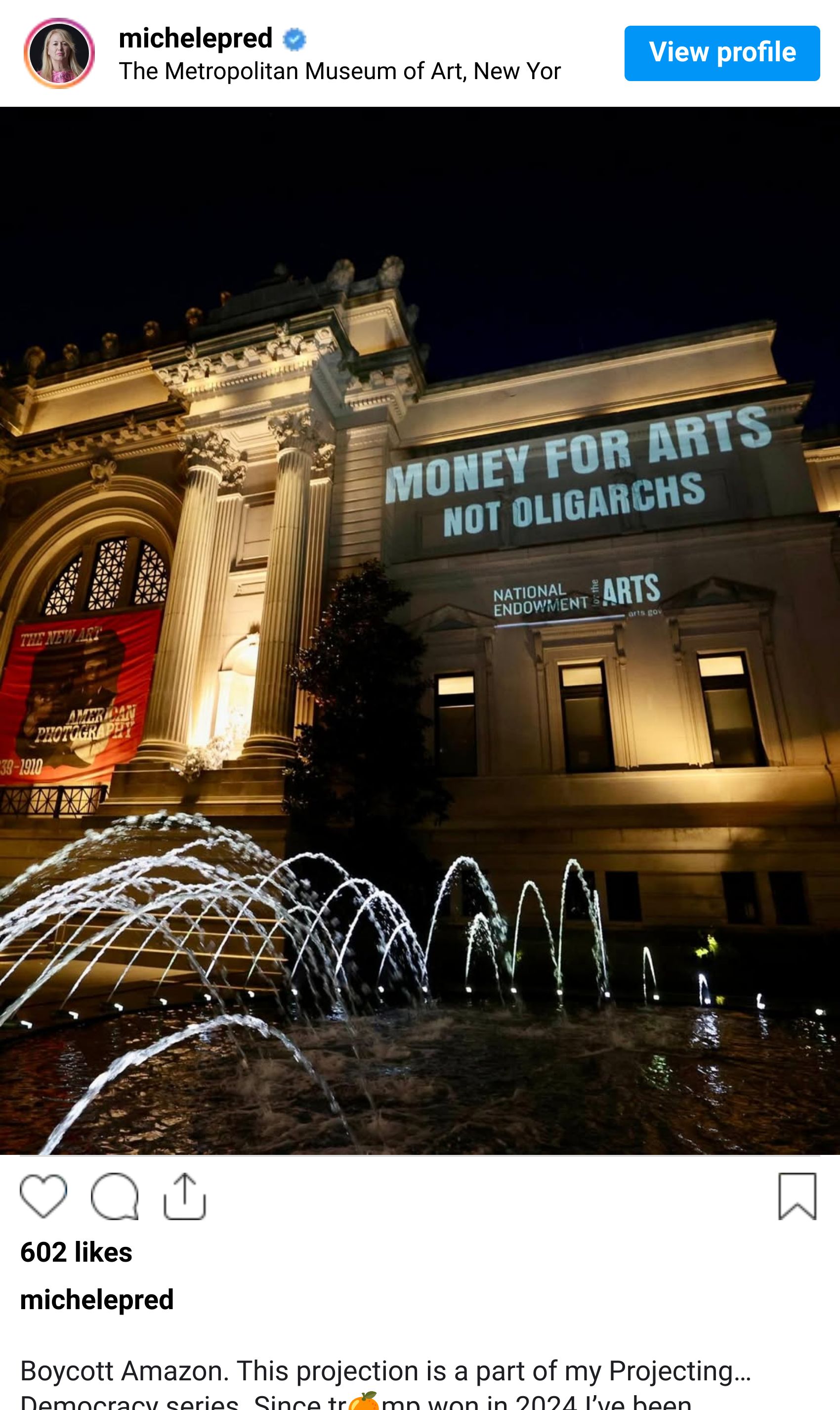
Another protest projection, this time on the facade of the Met Museum, by artist and activist Michele Pred:
In case you needed another reminder of how rich Jeff Bezos is: the New York Post reports he’s trying to sell his $500 million yacht, which has a $75 million support yacht. This grotesque flotilla of wealth apparently costs $30 million a year to operate (in other words, three Met Galas!).
The outfits in many ways felt almost beside the point this year, but Beyoncé was the most anticipated guest and she made a dramatic Met Gala return after not going for 10 years. She chose a glittery skeleton dress by former Balmain designer Olivier Rousteing. Her 14-year-old daughter Blue Ivy attended with her, even though the event’s age limit is generally 18, wearing Balenciaga.
The Met Gala Was All Money, No Soul
It’s impossible to talk about the Met Gala and not talk about figures.
The tickets: $100,000.
The tables: $350,000.
The amount the Bezoses spent to buy it: $10 million.
The amount this year’s gala raised: $42 million (up from $31 million last year).
The number of hours that went into the embroidery on Kylie Jenner’s couture Schiaparelli dress: 11,000.
The number of Swarovski crystals on Lisa’s Robert Wun dress: 66,960.
The number of additional arms on Lisa’s Robert Wun dress: 2.
The number of dresses with additional arms: I think two if you just include Jordan Roth; arguably three if you include the hand illustrated on Sabine Getty. (Do NOT make me go back through Vogue’s 253(!) outfits and make me count the looks with additional hands!)

Emma Chamberlain and Lena Mahfouf. (Photo: Matt Winkelmeyer/MG26/Getty Images for The Met Museum/Vogue)
The number of NYC mayors in attendance: 0.
Every year we receive these numbers because we are supposed to marvel over them, turn them into content, and use them as a benchmark for the following year, when everything will be more, because it is always more: more money charged, more money raised, more flowers displayed, more beads sewn, more hours of labor for Kylie Jenner’s gown. But what does all the “more more more” add up to?
Pull up a seat.
Back Row is a reader-supported publication covering how fashion and culture really work without PR gloss. Subscribe for exclusive reporting, insider scoops, and full access to every issue and podcast episode.
We live in a weird time when bad things happen, then more bad things happen and replace those bad things. It’s hard to keep track of all these bad things. It’s hard to know if any of the bad things will stick. For many, Bezos sponsoring the Met Gala cast the event in a deeply unflattering and unappealing light. However, as usual, the red carpet and party went on without much visible disruption. A demonstrator whom The Cut identified as Chris Smalls, founder of the Amazon Labor Union (the first independent union to organize U.S. Amazon warehouse workers), was seen in what looked like an altercation with authorities just outside the carpet. As part of his advocacy work, Smalls has stood alongside the fashion industry, notably supporting the efforts of The Model Alliance, run by Sara Ziff.
If removing him felt disingenuous for an industry that once claimed to stand for something, so did Vogue’s coverage. Vogue has been making an enormous deal of being more open, recently purporting to tell its audience all about what assisting Anna Wintour is really like, pegged to The Devil Wears Prada 2. Meanwhile, it’s Met Gala coverage seemed to have made zero mention of the Bezos protests or controversy associated with the event. While not surprising, it was notable given the general discourse.
Head of Editorial Content Chloe Malle, who spearheaded this recent effort to interview Anna’s former assistants, stopped to chat for Vogue’s red carpet livestream. She said she was on the host committee this year and that her job was to “make sure everyone is schmoozing correctly.” Asked if she was the “vibe police,” she conceded, “I’m the vibe police.”
Yet, the real vibe police was money. The Bezos money, the Colgate and Eli Lily sponsorship money, the corporate fashion money, lots and lots of money that overshadowed the Costume Institute’s work and made this year's event feel especially soulless and un-fun.
Lauren Sánchez Bezos walked the carpet in a navy blue Schiaparelli dress she said was inspired by John Singer Sargent’s Madame X painting, which is part of the Met’s collection. Only, her gown was navy (not black), and she wore it with the strap down (the wrong strap), which Singer repainted after backlash to the original portrait of Virginie Gautreau. Sánchez pointed out that she chose to wear the strap down. Was this an attempt at a subversive statement about identity, straps, her position in society…?Who knows? Absent from her arm was her husband Jeff Bezos. Weird, because as the New York Times recently told us, “She and Mr. Bezos do everything together.”
Bezos has been the primary target of protests around the city for weeks now calling for boycotts of the “Bezos Met Gala.” I can only assume the protests got to him or created safety concerns, because he had no problem walking the carpet in 2012 when Amazon sponsored the event alongside his then-wife MacKenzie.
Then, there was Mark Zuckerberg attending the gala for the first time wearing a boring Prada tux, alongside his wife, Priscilla Chan. They reportedly got to sit at Anna Wintour’s table. Why? Again, who knows? Because they’re among the top five richest people there? They also declined to walk the carpet, probably again owing to protests, though we’ll never really know. The New York Times wrote their attendance up with an uncredited photo. I have lots of questions and suspect I’ll never get satisfying answers.
Lots of commenters like to point out that hey, even if these tech oligarchs are bad, spending their money on the Costume Institute is good. Let them do it! Don’t be a hater. It’s for the museum! It’s charity.
That is true, but it’s also a big business opportunity for Vogue and Condé Nast. Anna Wintour used to insist on this being a charity event only, but given the state of the magazine industry, the company now sells it to sponsors. Hence, the first line of Vogue’s YouTube description on its Met Gala livestream: “Presented by Colgate, eBay, Eli Lilly and Company & On.” All the content Vogue captures from this event — that livestream, that slideshow of people on the red carpet, the “getting ready with so and so” videos, etc. represents inventory and “impressions” that Vogue can sell ads against. The event must be hugely profitable, because Condé Nast has seemingly reorganized itself around staging other lavish clipping opportunities, including Vogue World, the Vanity Fair Oscar after-party (sponsored by Dominos!), etc. However, turning the event into a backdrop for pharmaceutical and toothpaste marketing didn’t make it feel like the same celebration of the arts and creativity it once did.
Many guests stopped and chatted with Vogue livestream hosts La La Anthony, Ashley Graham, and Cara Delevingne. Anna Wintour stopped to talk with Anthony. She praised Costume Institute Chief Curator Andrew Bolton and talked about the event’s great economic impact on New York: hairdressers get work, hotels fill up, and tourists are inspired to come see the city. It felt like commentary directed at Mayor Zohran Mamdani, who declined to attend, instead partnering with i-D magazine to highlight members of the fashion industry in New York who would never be spotlit at the Met Gala: former Amazon delivery workers and labor rights activists, tailors, a Macy’s employee.
The Met Gala, of course, instead featured corporate brands as usual, like Gap, Zara, Chanel, and Dior, on paid ambassadors like Kendall Jenner and Nicole Kidman. The companies with lots of money, who can buy their way into the room, whose wins are powered by many laborers we’ll probably never see.

Joy on the Resistance Runway. (Photo: Selcuk Acar/Anadolu via Getty Images)
Just down the street, while Sánchez was working her fallen strap, another display took place. Advocacy group Rise and Resist drew dozens together for “Resistance Runway.” Emcee Jay W. Walker told Hyperallergic the gala was “such an exercise in triviality and an ostentatious display of wealth and power in a time when so many Americans are under serious, serious threat.” The group danced on the sidewalk to ABBA’s “Money, Money, Money.” They wore sparkly dresses and heels and embellished hats and fuchsia capes and feather boas. And they looked utterly joyous to be together making a fashionable statement about so many bad things in the world.
Maybe here, out on the streets, away from the “in” crowd, vibe police are not needed because the vibes are so good they don’t need to be policed.
What Premium subscribers are reading:


Amy Odell is the New York Times bestselling author of Gwyneth: The Biography; Anna: The Biography; and the essay collection Tales from the Back Row: An Outsider’s View from Inside the Fashion Industry. Write her at amy (at) amyodell (dot) com. Submit a tip or story request anonymously here.
Partnership inquiries: [email protected]
Back Row may earn commission if you purchase through affiliate links in this newsletter, which helps support the operations of this publication.
