
💌 Forwarded this email? Sign up here and if you have tips or story requests, submit them here.
This issue is a day early owing to my travel schedule this week. I’ll be back in your inbox Thursday with the Premium edition. There is no “Loose Threads” today.
🎙️ New on the Back Row podcast: Fox reality show The Swan premiered in 2004 with a brutal premise for contestants: leave home for months, get plastic surgery, crash diet, and then appear in a beauty pageant.
The Hulu documentary The Swan: Behind the Mirror revisits the show and interviews the contestants — one of whom had 15 plastic surgery procedures for the show — 20 years later. Director Erin Lee Carr joined me to discuss the contestant who nearly died; how much say the women had in their procedures (spoiler: virtually none); and the surprising answers women gave when asked if they’d do it again. The full episode is free to watch/listen to on YouTube, Spotify, and Apple Podcasts.
Today’s newsletter is free to read, so please share it with at least one person you know who would like it. A lot of work goes into these free issues, and getting friends to sign up is a great way to show your love for the work you find here. Plus, you’ll get complimentary access to Premium issues when enough of your friends use your referral link:
Please take a few minutes to fill out Back Row’s fall boot survey! I’ll share the community’s recommendations in an upcoming issue.
Guards at Dior, Rats in French Schools
Over the weekend, my feed was a dystopian mix of rich celebrities arriving at the Academy Museum Gala wearing the world’s most lavish clothing, juxtaposed with footage of France. Across the country, looters ransacked businesses like Celine, Louis Vuitton, and Rolex, while peaceful protesters marched to call attention to severely underfunded schools, the cost of living, and pensions.

(Photo: Matthieu RONDEL / AFP via Getty Images)
Astonishing videos showed rioters storming luxury stores, breaking down their doors, smashing glass cases, and throwing bags into the streets by the armful. In Marseille, Hermès looters hurled orange boxes onto the cobblestones, transforming them from influencer flotsam to trash left to be trampled. Small, local businesses with fewer resources to defend and rebuild were also targeted. Graffiti was scrawled onto the windows of luxury boutiques for retailers like Van Cleef & Arpels and Bucherer that read "ACAB" (all cops are bastards) and "taxer les riches." LVMH chief Bernard Arnault figured into one of the protesters' more lewd displays.
The protests in France have been building for weeks, as demonstrators demand the government spend more on education (”There are cockroaches and rats everywhere in the school,” one 17-year-old French student told Reuters), do something about the cost of living, and raise pensions.
Violence is never acceptable. Still, the footage that ricocheted across social media provided yet another example of luxury fashion becoming a potent and highly visible symbol of inequality. In the US, we saw peaceful protests when the Bezoses paid for the Met Gala. In France, Arnault seems to loom over daily life the way Big Tech CEOs do in America. His industry has been walking away from all but the ultra-wealthy, with an estimated 50 million shoppers exiting the luxury market between 2022 and 2024.
Unlike many of its customers, fashion hasn’t retreated into isolation. Private members’ clubs have exploded in popularity among the uber-wealthy since the pandemic, yet they remain largely unseen. Meanwhile, virtually everyone can observe high fashion, which has become akin to a spectator sport. It exists as its own form of entertainment (it also props up the entertainment industry). Brands invest heavily — in runway livestreams, influencer gifting, celebrity front-row “ambassadors” — in order to ensure as many people as possible see what they can never have. They pay to dress stars for the Met Gala and movie premieres. They send influencers on ostentatious trips with the expectation that they’ll post about them.
Support Independent Fashion Journalism
Back Row is able to operate thanks to paying members. Join the community to support the independent journalism you find here, and unlock these stories:
“Honestly, 80% of what people think they know is a lie,” said a recent Hermès Paris employee about how people manage to buy Birkin bags.
The mistakes mistresses made when their lovers took them to buy Chanel.
Clients say Chanel tried to police their social media posts about the brand.
They also profit from exclusion. Part of the longtime appeal of Hermès quota bags was that almost no one could get one. You had to either be a "someone" or hobnob with salespeople and spend thousands for the privilege of being offered a Birkin in a select city, like New York or Paris. The optics of Hermès's "game" have gotten worse as the bags have become seemingly ubiquitous. As France burned, the Wall Street Journal published a story detailing Hermès's push into suburbs like Short Hills, New Jersey and Wilmette, Illinois. A Tampa store is coming in the new year. “The data will show you that there are billionaires in 47 states," Diane Mahady, Hermès’s chief executive for the Americas, said. Hermès doesn’t seem to be selling scarcity anymore, but the prices just keep going up.
The Met Gala is the industry’s annual monument to all of this. In recent years Big Tech and its billionaires started paying for it. Vogue made the Gilded Age the basis for the dress code at the 2022 gala, as though unaware that while the period embodied style and taste for the wealthy, it was also one where the poorest were living in squalor in tenements with no chance of upward mobility. Rather than dial back the event’s visibility, Vogue continues to blast it as wide as possible to monetize it via online “impressions.”
Meanwhile, Arnault — France’s richest man — has called a proposed tax on the ultra-rich a way “to destroy the French economy.” (It’s been voted down repeatedly, most recently on Friday before the violence broke out.)
As if Arnault were looking to contribute images that illustrate the capitalist excess that creates such divides, videos depicted a line of private security guards standing outside of Dior in Paris, protecting $5,000 bags and $10,000 dresses, as though they were life itself.
The luxury boutiques will likely rebuild and go back to the way things were: relentless marketing, relentless expansion, relentless price increases. Fashion can't fix France's budget and it would be foolish to expect it to. But these brands are easier to target than other rich people stuff (private jets, mansions, etc.) and this is surely not the last we’ll see of luxury fashion becoming a symbol of a broken world.
Annual Reminder That If Brands Pay Stars To Show Up to Stuff, They Generally Do
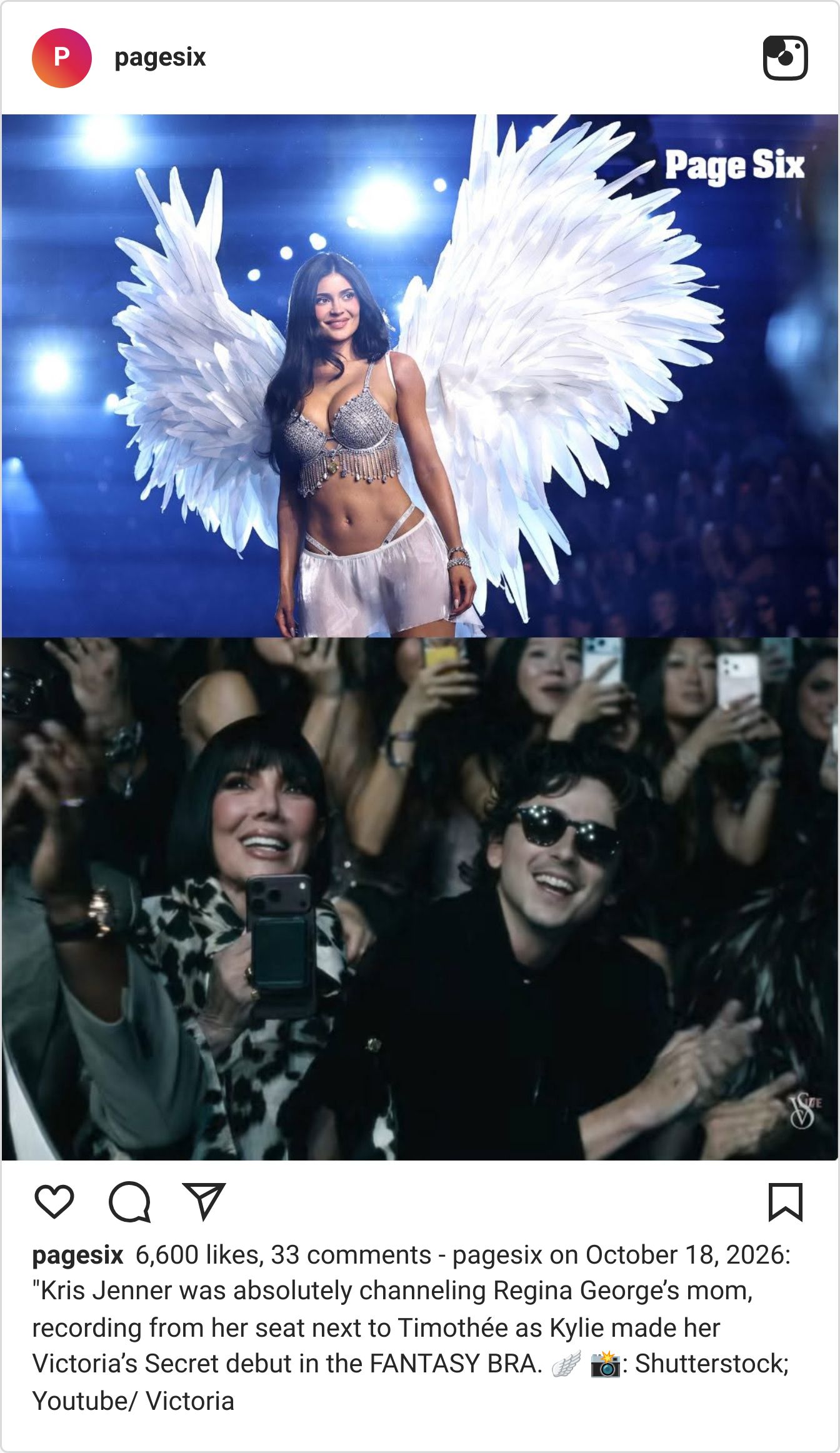
The Victoria’s Secret Fashion Show is somehow back to being an annual event where women walk the runway in high heels and underwear in the name of holiday marketing. A few highlights:
Kylie Jenner wore the diamond-encrusted “fantasy bra,” which was valued at $50 million.
People got upset that Kylie got to wear said fantasy bra, as though this were the real issue with this show.
Nicole Kidman sat front row.
Lisa Rinna attended wearing a literal feather in her cap.
People posting about this event on social media genuinely seem to like it, though it’s also likely Victoria’s Secret paid for a clipping campaign that gives off that impression.
I asked people on Instagram what seeing Kylie in a $50 million bra and stilettos on the runway was supposed to make us feel, and responses included: “empty,” “disappointment,” and “back pain.”
Hailey Bieber, Whose Brand Once Sold 36 Units of ‘Peptide Glazing Fluid’ Per Second, ‘Not Interested in Overconsumption’
At a Fortune conference last week, Bieber said, “I’m not interested in overconsumption.” The clip went viral and the internet, unsurprisingly, did its thing.
Props to Bieber for being one of the few celebrities to figure out this whole “starting a beauty brand” thing and sell her company to e.l.f. in a deal valued at $1 billion. The road is littered with stars who couldn’t do it.
However, I’m going to take a swing and say that customers aren’t looking to Bieber or Rhode to have a set of values aside from “glazed donut.” The very premise of a celebrity makeup brand is convincing people to spend money on things being added to an already highly saturated market. These stars often say they had to start their lines because they couldn’t find a product that did exactly what they wanted. (“I’m not interested in putting a bunch of stuff out there just to put it out there,” quoth Bieber.) But consumers know how business works and that this is bunk.
Speaking of Celeb Beauty, That’s Probably Why J. Law Joined Instagram
Why would Jennifer Lawrence suddenly join Instagram in 2026? To promote the art of cinema? To view and engage with “the discourse”? Probably neither.
Apparently she’s launching a haircare brand called “mes” with a little degree sign at the end of it that no one has the skills to type out except, probably, the person who published this story about it in Women’s Wear Daily.

Scarlett Johansson, whose The Outset beauty line recently folded, also popped up on Instagram on her brand’s IG account around the time that launched. Obviously people are more likely to follow Lawrence than mes [degree], so it makes sense for her to get a head start in order to help grow and market the brand’s page.
What this does for her reputation as a “cool girl” who seemed above this type of thing remains to be seen. However, Beyoncé’s Cécred, I’m told, sells well, and her fans are still in the tank for her, so it can be done.


Amy Odell is the New York Times bestselling author of Gwyneth: The Biography; Anna: The Biography; and the essay collection Tales from the Back Row: An Outsider’s View from Inside the Fashion Industry. Write her at amy (at) amyodell (dot) com. Submit a tip or story request anonymously here.
Partnership inquiries: [email protected]
Back Row may earn commission if you purchase through affiliate links in this newsletter, which helps support the operations of this publication.
